At PCIM, Power Integrations presented its latest SCALE-2 Plug-and-Play Gate Driver targeting railway applications, and its latest innovations in the electric vehicle (EV) market with the AEC-Q100-certified 900 V InnoSwitch3-AQ Flyback Switcher ICs. Thorsten Schmidt, product marketing engineer, gate drivers industrial, Edward Ong, senior product marketing manager, and Peter Vaughan, director of applications engineering, all of Power Integrations, said in an interview with Power Electronics News that in addition to the automotive market, which is the largest and fastest-growing market for IGBTs from an industrial perspective, railway is another interesting application area with ever-changing and -growing requirements, so it is necessary to keep up with increasingly stringent demands in terms of robustness and reliability. On the same level, the EV market is also undergoing major changes to meet the demands of fast charging.
“Depending on where we are, rail systems must be able to withstand extreme variations in temperature; on the other hand, ease of use is also essential,” said Schmidt. “You may think that there is a lot of space available inside the train to fit a converter, but in reality, this is not the case. Therefore, a high level of integration is appreciated by railway manufacturers as well as, of course, comprehensive protection features to make sure that a train does not stop because, for example, the IGBT module breaks down due to a defect in a gate driver.”
It is therefore essential that the product has a long service life, and so the implementation of special components are necessary. At the same time, quick and easy maintenance must be achievable.
“Our new plug-and-play IGBT driver is specifically designed to meet railway industry needs. Devices feature: conformal coating for protection against contaminants, dust, and humidity; excellent mechanical robustness against bending and component cracking; and rugged connectors to ensure interconnection security,” said Schmidt.
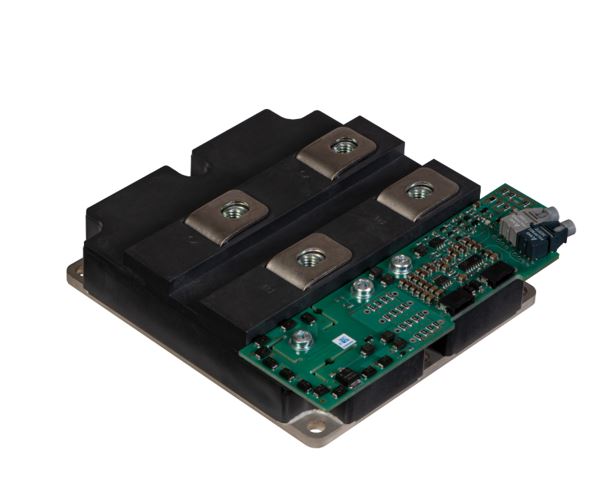
At PCIM, Power Integrations presented a specifically designed plug-and-play gate driver in the 130 × 140 mm form factor, as shown in Figure 1.
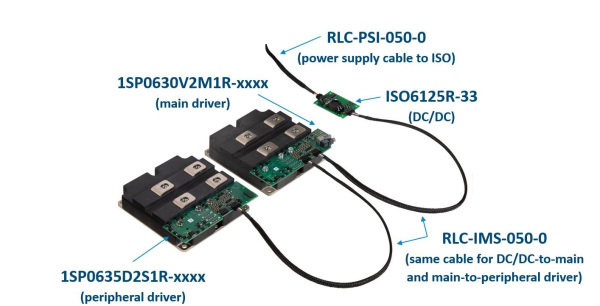
Comprising the 1SP0630V2M1R main driver, 1SP0635D2S1R peripheral driver and ISO6125R-33 power supply, the new SCALE-2 plug-and-play gate drivers streamline system development and installation. The new gate drivers are particularly beneficial in systems requiring parallel modules for additional power, providing simplicity and flexibility in both electrical and mechanical design.
Power Integrations emphasized that this is a product specifically designed to withstand environmental influences such as, for example, dust or moisture that could settle on the PCB and thus lead to corrosion of certain components and therefore a malfunction. “For this, we apply a conformal coating,” said Schmidt. “This is a special type of protection that is sprayed onto the board using a highly automated and very robust and reliable process with automated optical inspection.”
Schmidt pointed out that the new product has a high degree of robustness to prevent excess force from being applied which might break the device. Therefore, the PCB cannot being severely flexed. “SCALE-2 1SP0630 has excellent mechanical robustness against bending and component cracking, and rugged connectors ensure interconnection security,” he said.
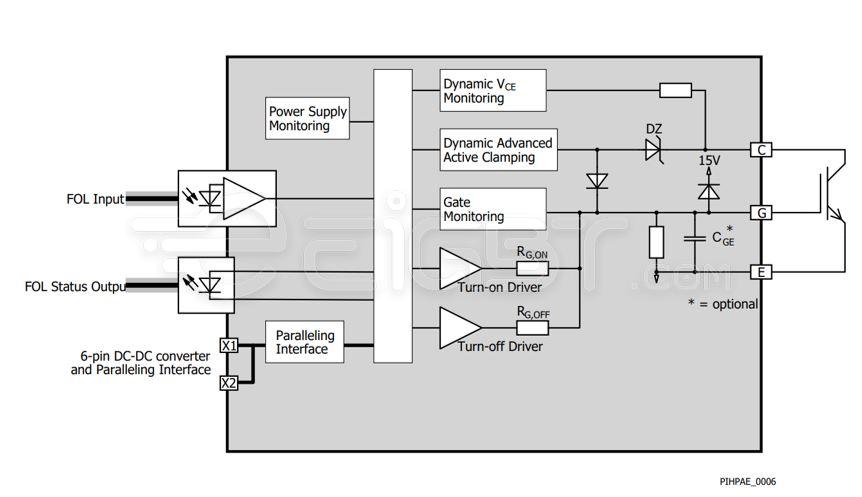
The new IGBT driver features plug-and-play installation, just like a graphics card, said Schmidt (Figure 2). “We designed it mechanically so that it fits perfectly onto the IGBT module. And we also characterized it electrically so that our drivers always operate correctly with the IGBT module. In terms of scalability, the driver can operate with up to three modules in parallel, simply by having a cable connection from our main driver, as shown in Figure 3, with an easy parallelization interface.”
SCALE-2 gate drivers enable designers to optimize dynamic switching performance, accuracy and functionality and include advanced active clamping circuitry to protect the IGBT.
The EV market is moving toward higher bus voltages above 800 V to meet customer demands. Most EVs use a 400 V bus, but the industry also employs an 800 V bus used in commercial and high-performance vehicles. This reduces current in cables and enables faster charging with less heat and a lower weight. To support this market, Power Integrations is presenting a new member of the InnoSwitch3-AQ family at PCIM.
“The 800 V bus allows a faster charging time and also minimizes the weight of the vehicle,” said Ong and Vaughan. “The other interesting thing to note is that more and more commercial vehicles are operating beyond 800 V- many are migrating to the 900 V bus voltage. But bus voltages are likely to change, depending on the customer or the manufacturer. And so you need to have a scalable solution for auxiliary power to be able to accommodate the different buses for each level readily.”
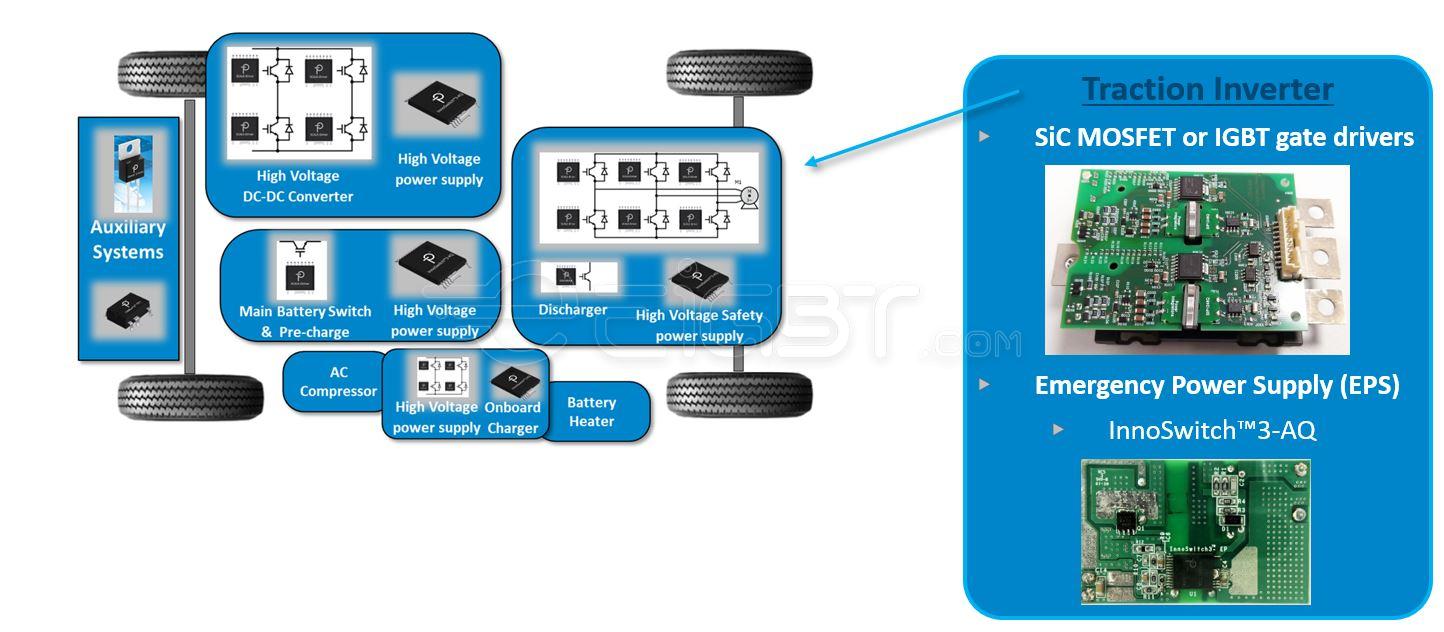
An EV consists of a series of functional blocks, as shown in Figure 4, and in particular, we can note the propulsion inverter that pushes the car and drives the electric motor. Optimized gate driver solutions are based on SiC and IGBTs. The new international ISO 26262 standard requires the vehicle to be designed to be functionallysafe, with the EV safe to use even in a fault condition.
Power Integrations’ InnoSwitch3-AQ was launched last year in the surface-mount InSOP package. Initially, the AEC-Q100–qualified flyback switcher featured an integrated 750 V MOSFET, now, this week at PCIM, the 900 V version (INN3996CQ) was presented.
The InnoSwitch3-AQ family combines primary and secondary controllers plus safety-rated feedback circuitry into a single IC. This allows accurate output voltage regulation, low component count and configuration options for operation over the ultra-wide input voltage range of 30 V to 1200 V.
“The new 900 V INN3996CQ ICs provide plenty of voltage headroom and meet the Automotive Electronics Council’s strict requirements for qualification ensuring safe and reliable operation in the demanding automotive application. Using a StackFET approach, the new device is suitable for 900 V and greater bus designs,” said Ong and Vaughan.
The family of auto-qualified devices addresses automotive EV applications such as traction inverters, on-board chargers, EMS (power management DC/DC bus converters), and battery management systems. It supports external StackFET for 800 V and abovebus voltages and uses the FluxLink high-speed communications technology invented by Power Integrations as the magnetic coupling between the primary and the secondary side, meaning that optocouplers are not required. FluxLink technology maintains output voltage regulation even during transient stress testing, which is particularly challenging for PSR-based implementations.
The emergency power supply (EPS) provides power to safely steer and slow down a vehicle in the event of battery failure. It operates from a high-voltage battery rail and supports operation even with a compromised main voltage bus. InnoSwitch3-AQ for EPS draws power from the HV bus. It provides power to drive the motor control and traction controller.
“In order to extend the voltage range, Power Integrations offers a 900 V device, and to further extend the voltage range for the input to 1,200 V, we add an external MOSFET essentially in a cascaded configuration that we call Stack, and that allows us to support up to a 1,200 V input,” said Ong and Vaughan. Power Integrations pointed out that the useful thing about this configuration is that the internal switch still provides all the startup protection functions. So you just do a standard design, add the MOSFET, and then the add-ons in the blue dashed box in Figure 5 to have a scalable solution up to 1,200 V (400 V bus use INN3996CQ, 800-V–plus bus use INN3996CQ + StackFET).
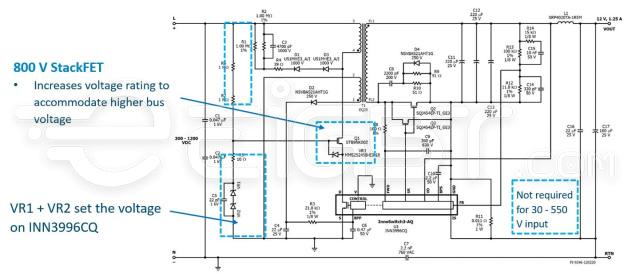
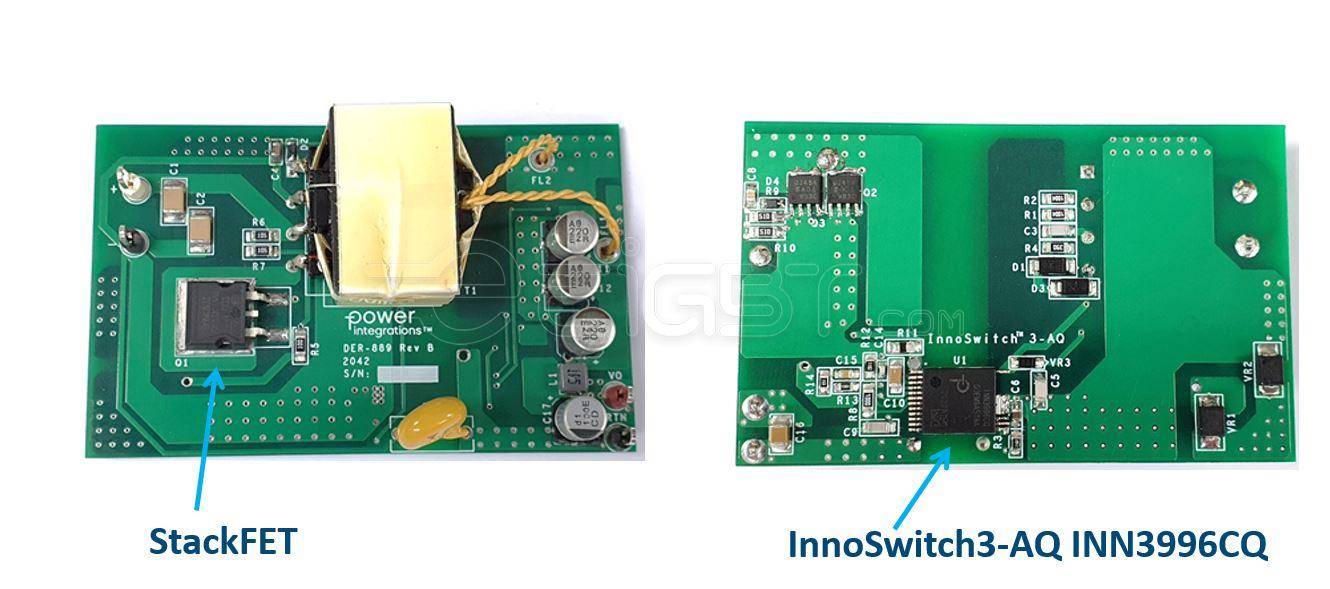
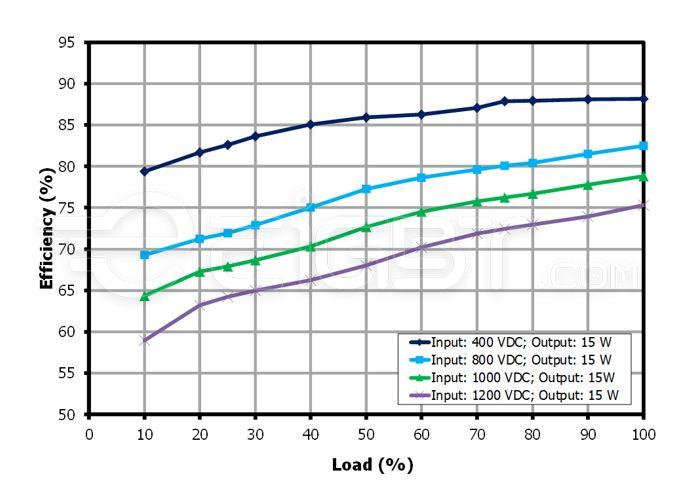
“Automotive power supplies do not allow the use optocouplers, and Fluxlink allows us to eliminate the optocoupler, achieving very accurate output regulation and also very fast load transient response” said Ong and Vaughan. “This automotive-qualified flyback controller meets EPS requirements for increased bus voltages.” EPS high efficiency is realized using an automotive-qualified flyback controller with integrated 900-V MOSFET (INN3996CQ) + StackFET, and accurate output voltage regulation down to +1%/–3% is achieved.
InnoSwitch3-AQ ICs operate down to 30 VDC, enabling automotive designers to use the device in traction inverter emergency power supply applications.
For More Information
Contact: Vicky
Phone: 86-13410359515
E-mail: Sales@eIGBT.com
Add: D1,6th Floor,Tower 13,Lehui Center,Jihua Roard 489, Longgang District, Shenzhen, China
